Wednesday, 25 March 2020

March 25th


During this time of self-isolation, I have been reading Dickens again, partly from nostalgia and mostly because it’s good to read about good and evil and bleakness and optimism and to know that at the end it will all turn out all right. Reading Barnaby Rudge today, I came across a reference to March 25th “which, as most people know to their cost, is, and has been time out of mind, one of those unpleasant epochs termed quarter-days. On this twenty-fifth of March, it was John Willet’s pride annually to settle, in hard cash, his account with a certain vintner and distiller in the city of London.”
It got me thinking that it would be a good thing these days to have an annual account with a vintner and distiller.
Settling into the nostalgia I got to thinking about how as a child of about ten years I had memorized the entire catechism of the Presbyterian Church which I pursued because the Minister of our church paid a dollar—a lot of money at the time – as a reward for this feat and also because I liked the language. I particularly liked the question What is the chief end of Man? The answer was Man's chief end is to glorify God, and to enjoy him forever.  Somehow I took that to mean that we should all have a good time, and in the following years I did too much of that.
Although I was never christened and continue to be a heathen, I was happy to memorize Corinthians I, Chapter 13, for my Explorers’ group. I liked phrases like, “Though I speak with the tongues of men and of angels, and have not charity, I am become as sounding brass, or a tinkling cymbal.” Sounding brass! Tinkling cymbal!
Charity interested me because, when I was very young, because my mother gave me three illustrated Sunday School cards from her youth which featured the three theological virtues of Faith, Hope and Charity. I loved them and likely still have those cards somewhere, probably in one of the boxes labelled “Nostalgia.” The angelic creatures on those cards were all beautiful and saintly with sweet smiles and uplifted gazes but the one I liked best was Charity, because she had a basket over her arm and actually seemed to be doing something helpful, not just thinking about it.
As a teenager I learned about the Seven Deadly Sins. I could recite them without hesitation and, from time to time, practised all of them. Pride. Ire. Gluttony. Sloth. Lust. Envy. Greed. It occurs to me now that those are the things that have brought us to where we are now in this strange time of the coronavirus.
I think there is a change happening these days. I find evidence of much kindness, a good deal of charity. And, of course, we hope. And there is faith that we will get through these uncertain times. Those three theological virtues have been linked with the four cardinal virtues to form the Seven Heavenly Virtues. Faith. Hope. Charity. Prudence. Justice. Temperance. Courage. The opposite of the Seven Deadly Sins. We may need all of these to see us through the coming weeks and months.
Self-isolation is a time of reflection. Many people are saying that they now find what they had thought was important is, in fact, not what really matters. Many are displaying charity and courage and other thoughtful behaviours. All the Heavenly Virtues may gain popularity. And, as the bible says, the greatest of these is charity. And it has never been needed more.
At the moment, I am not quite sure about Temperance, however. I find a little wine helps, and I hope that, like John Willett in Barnaby Rudge, I will still be around next March 25th and will be quite ready to settle my account with the vintners and distillers.


Sunday, 22 March 2020

Planet Earth


Some of us are looking for the silver lining at this stressful time. Given the rapid spread of the Covid-19 virus, the deaths, the hard times that so many are facing, and the fear that we all feel, this is not an easy task. And some of the optimistic stories we hear aren’t true. It was disappointing to learn that the dolphins aren’t actually returning to Venice, despite the lovely video that circulated so quickly. Perhaps we are being too hopeful.

And yet there are some good things worth noting. The canal water in Venice has cleared, even though there are no dolphins. There are reports of blue skies in China and of smog lessening in Seattle. Peter Gleick, a climate scientist and founder of the Pacific Institute in Berkeley says that “As for the environmental benefits we see from the slowdown of day-to-day life and economic activity in terms of improving air quality and other slight benefits, it’s a good sign that our ecosystems are somewhat resilient if we don’t completely destroy them.”

Things could improve. It’s also possible that the economic response to Covid-19 will be not have any focus on stimulus packages that consider climate change. Airlines are asking for billions of dollars in government aid, which President Trump has endorsed, and air travel may bounce back after the pandemic subsides. The resurgence in industrial activity may outweigh short-term reduction of emissions. The climate crisis challenges will remain.

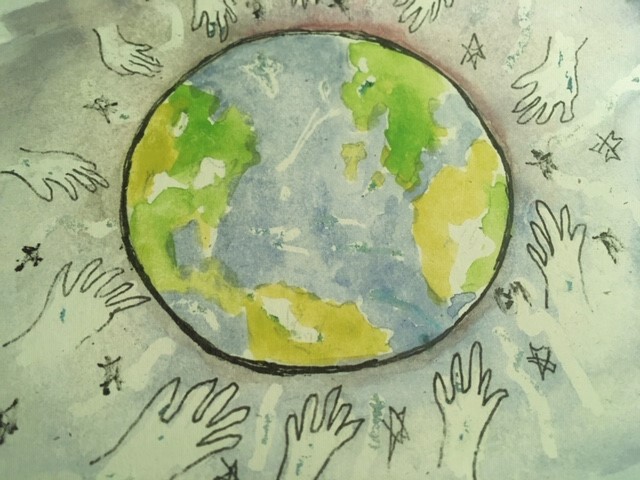
Many people are using this time to hike and cycle and enjoy the natural world. More than ever we are talking about the need to take care of our planet. I find myself thinking of P K Page’s wonderful poem, “Planet Earth” in which she says, It has to be spread out, the skin of this planet, has to be ironed, the sea in its whiteness; and the hands keep on moving, smoothing the holy surfaces…It has to be loved the way a laundress loves her linens…like a lover coaxing, or a mother praising…” It’s worth taking a few minutes to listen to P.K. reading this remarkable poem which has been read aloud in such places as the Mount Everest Base Camp and the Antarctic Research Station.


Let's hope that the Covid-19 epidemic will help us to see the planet differently and to understand that we are just one of the many peoples and many species who make earth their home. Maybe we will develop compassion for other people and various species. Maybe we will develop an appreciation of the trees and plants and rivers and oceans that surround us. Maybe we will see the earth differently and learn to love and care for our planet.


Thursday, 19 March 2020

The Bottom Falling Out


A few afternoons ago, I decided to sit down with my book and a glass of wine. And then, thinking that this may be a time to be more than usually disciplined, I poured myself a glass of clamato juice instead. As I was about to sit down, I saw streams of red trickling from the bottom of the glass and when I lifted it, the clamato juice flowed freely. The bottom fell out! The glass had split at the base, a clean break, and I was holding only the empty top half. I’d not seen that happen before.

After I cleaned the table and carpet, I decided to check online to see how my small portfolio was doing. The picture seemed very similar there.

The really weird thing is that the next evening, when I removed the small casserole I had baked in a clay and ceramic pot I have used for years, the bottom fell out of it as well, spreading beans and potatoes all over the kitchen counter.

The message was clear. I should not be checking my investments portfolio but, instead, focusing on other things. This is what I decided for myself:

·        It’s time to stay in close touch with loved ones. Even when self-isolating I can send emails, texts, and have phone conversations.

·        I can appreciate and thank all the people who are carrying on with their work staffing hospitals and other community services, cleaning homes, delivering mail, picking up garbage, and myriad other jobs that I sometimes forget to notice.

·        I can take the time to thank and continue to thank our governments –local, provincial and federal – and our medical practitioners and health professionals for the great job they are doing under extremely stressful conditions.

·        Since I find myself stuck at home for the next few weeks, I can take up the activities I often neglect because I don’t think I have time for them: playing the piano, reading, keeping a journal, exercising, sketching, birdwatching.

The bottom may fall out of my portfolio, but it’s only money. I can recover. And, if I keep doing all those things on my list, perhaps the bottom hasn’t fallen out of the cornucopia of potential activities. There are many good things to pursue.

There’s not use crying over spilt clamato juice. I will settle now for a glass of wine. And get back to my book.


Sunday, 15 March 2020

Prevailing


William Faulkner said, when accepting the Nobel Prize in 1950, “I believe that man will not merely endure: he will prevail.” Because, he said, he believed in the soul, “a spirit capable of compassion and sacrifice and endurance.”

Good words to remember, in these strange times. The next months will be challenging, but it could be that a spirit capable of compassion and sacrifice and endurance will see us through.

We are, now, in a situation we did not anticipate.  We might have figured out that our sense of security would not last forever. But here we are in a “new normal,” as many say, and we must do the best we can.

A few weeks ago, my dear friend Paula brought me this air plant, or wind plant (Tillandsia) in a black Murex shell. I love it. It doesn’t require much attention and will live for many years with minimal care.

Right now, I'm trying to emulate it. I think the next few months will be difficult. I am old, and am ready to die, if it comes to that. I'm at risk at least in part because I have taken too little care of my health through the years. What concerns me, though, is not my own future but the larger things -- the infrastructure, the economy, and other events that will affect my granddaughter and the other much-loved young people in my family.

I tried tonight to make a sketch of my wind plant in its Murex shell, along with a folk art carving that a dear friend brought us from Nova Scotia. In the sketch is also a small cup I treasure that my husband brought me many years ago.  It is just a small cup but I filled it with sherry -- and may refill it.

My drawing isn’t any good, but I’m going to post it anyway. Given the circumstances, it may have been the best I could do. What I have done throughout my life, including my many regrets, may have been the best I could do.

Faulkner was right to draw our attention to the spirit capable of compassion and endurance. But maybe we should start with compassion for ourselves, in order to move forward and follow through with the sacrifice and endurance we will need in order to support others.

The days ahead will be difficult, but let us prevail.

Thursday, 12 March 2020

Redemption!


Recently I wrote a letter to the editor of our local newspaper to praise the work of our community food bank, and the editor chose to print it as a Guest Colum:
https://www.nanaimoloavesandfishes.org/volunteering/letter-editor-march-2020

I was pleased to make the point that the Three R’s of Reduce, Re-use, Recycle have been augmented by two additional actions which are Refuse and Repurpose, and I proposed that Loaves and Fishes adds a further and important activity which is Redistribution.
In these challenging times, Redistribution may be the most significant thing we can do. With the crash of the stock market and the resultant loss of employment, many people will be greatly in need of assistance. And just as there is an abundance of food which, through the work of organizations such as Loaves and Fishes, is redistributed, there is also an abundance of wealth in the hands of a very few people. It too can be redistributed. Let’s support the politicians and governments that introduce measures to redistribute that wealth. The uber-rich can afford to share!

In the meantime, even those of us who have much less money to throw around can participate in redistribution by being more than usually generous to homeless people and the organizations that support them: the shelters, the foodbanks, and the social agencies who help out. If you can afford to buy groceries, you can afford to ask the cashier to add a few dollars for the food bank.
It occurs to me now that, by performing these R’s, we may discover a seventh R: Redemption.

These days we mostly hear about Redemption in terms of redeeming Air Miles or Aeroplan points in order to get free trips. But practicing the six R’s listed above offers a different kind of redemption. Not a trip to Rome or Paris or Thailand -- nor even an admission to Heaven -- but perhaps it will give us a sense of having atoned for some of our thoughtlessness. The word comes from the Old French ’redimer’ which means to deliver or to buy back.  

Redemption! It’s a good feeling.

Wednesday, 4 March 2020

Another Form of Life


Lab Dispatch ABCV2020xv7v

Our current initiative is progressing well with successful activity in more than 100 countries and over 4,000 deaths reported. Almost 115,000 individuals have contacted the virus and it is spreading rapidly despite uncoordinated human efforts at containment. It is possible that this virus could be the downfall of the human race but it remains more likely that their own behavior will bring about their end. Humans are consumptive beings, and their self-knowledge is slight.

Humans consider us to be another form of life, which is interesting because that is similar to our perception of them. We define them as a large, slow-moving life-form with limited capacity for social innovation and collaboration. Because they are so disproportionately hefty, especially in relation to their intelligence, they think of us as invisible, although they do now have mechanical aides which allow them to catch glimpses of some of us. Incidentally, humans are an unattractive species, whereas we small creatures are extraordinarily beautiful and diverse. Age cannot wither nor custom stale our infinite variety, as one of their species wrote about an apparently exceptional human being.

As the most abundant entity and oldest life form on this planet, as well as a powerful presence in the vast universe, we have no reason to fear these ungainly creatures. Remember the dinosaurs? Despite the hubris that causes humans to seek endlessly for means to destroy us, they will continue to be at our mercy in the little time that remains before they ultimately destroy themselves.

There are some causes for us to be concerned, however. On earth, there is currently an unusual convergence of interests resulting from our coronavirus (one of our more captivating species), the alleged climate crisis, and the resurrection of indigenous wisdom. What evolves from this convergence may extend human life beyond what currently seems likely. For example, investments in oil and gas are plummeting, plane travel is decreasing, especially on flights from Britain and North America to Northern Italy, Frances, Singapore, China and South Korea, and every day more and more airlines are slashing flight itineraries.  Conferences are being held using distance technology and many people are focusing their attention on the land where they make their home, on a sense of place, and on an appreciation of their environment. What humans call The Stock Exchange is reacting wildly to this new behaviour, and there is some understandable concern and even panic about the short-term effects that may be experienced.

At the same time, from our perspective, we are also concerned that, if these trends continue, we will need to reconsider our projections, as we may have counted too heavily on the extinction of human life resulting from their addiction to travel, to comfort, and their boundless addiction to consumerism. Unless our current initiative is extremely successful, humans may have a longer future than we have envisioned.

In conclusion, however, remember that humans constitute no threat to us. On the contrary. But it would be nice to be rid of them sooner rather than later, so that the planet can thrive through the flourishing of other animals and plants with whom we have a more congenial relationship and for whom we have greater admiration.


Thursday, 2 January 2020

New Decade


On the eve of this new decade I once again read W.H.Auden’s poem September 1, 1939 and was struck by his reference to being “uncertain and afraid as the clever hopes expire of a low dishonest decade.” What adjectives would we use, I wondered, to describe the decade just passing? I decided that “greedy and diverted” would describe it best.
Through the past decade we have seen increases in wealth, homelessness, violence, hate crimes and endless consumption, and we have participated in diversions and distractions that might take our mind off such things. But lately it has become more and more difficult to ignore what's happening around us. Whether you're looking at videos of the raging fires in Australia, or watching a mourning ceremony for the disappearing Pizol glacier in Switzerland, or attending a vigil on Gabriola Island to protest anti-Semitic graffiti and swastikas sprayed on a Jewish summer camp, it’s difficult to escape from the shocking developments in our world, globally and locally. 
Elizabeth Hayhoe, a climate scientist at Texas Tech University says, “The science tells us that every gigaton we cut counts,” in avoiding a catastrophic future. I believe it is also true that every positive step we take to improve the lives of those around us counts in reducing hatred and violence.
Auden says, “Those to whom evil is done do evil in return” and “We must love one another or die.” I think he’s right and the moment is critical. Let’s do what we can to “show an affirming flame.”
 
It’s a timely poem. Worth reading at the start of this decade. We need to look at what’s going on in the world and use clear-sighted 20/20 vision. And we need to be acting, rather than distracting. It’s time.
 
Auden’s poem is also timely. It’s worth reading.

September, 1939

I sit in one of the dives
On Fifty-second Street
Uncertain and afraid
As the clever hopes expire
Of a low dishonest decade:
Waves of anger and fear
Circulate over the bright
And darkened lands of the earth,
Obsessing our private lives;
The unmentionable odour of death
Offends the September night.

Accurate scholarship can
Unearth the whole offence
From Luther until now
That has driven a culture mad,
Find what occurred at Linz,
What huge imago made
A psychopathic god:
I and the public know
What all schoolchildren learn,

Those to whom evil is done
Do evil in return.

Exiled Thucydides knew
All that a speech can say
About Democracy,
And what dictators do,
The elderly rubbish they talk
To an apathetic grave;
Analysed all in his book,
The enlightenment driven away,
The habit-forming pain,
Mismanagement and grief:
We must suffer them all again.

Into this neutral air
Where blind skyscrapers use
Their full height to proclaim
The strength of Collective Man,
Each language pours its vain
Competitive excuse:
But who can live for long
In an euphoric dream;
Out of the mirror they stare,
Imperialism's face
And the international wrong.

Faces along the bar
Cling to their average day:
The lights must never go out,
The music must always play,
All the conventions conspire
To make this fort assume
The furniture of home;
Lest we should see where we are,
Lost in a haunted wood,
Children afraid of the night
Who have never been happy or good.

The windiest militant trash
Important Persons shout
Is not so crude as our wish:
What mad Nijinsky wrote
About Diaghilev
Is true of the normal heart;
For the error bred in the bone
Of each woman and each man
Craves what it cannot have,
Not universal love
But to be loved alone.

From the conservative dark
Into the ethical life
The dense commuters come,
Repeating their morning vow;
"I will be true to the wife,
I'll concentrate more on my work,"
And helpless governors wake
To resume their compulsory game:
Who can release them now,
Who can reach the deaf,
Who can speak for the dumb?

All I have is a voice
To undo the folded lie,
The romantic lie in the brain
Of the sensual man-in-the-street
And the lie of Authority
Whose buildings grope the sky:
There is no such thing as the State
And no one exists alone;
Hunger allows no choice
To the citizen or the police;
We must love one another or die.

Defenceless under the night
Our world in stupor lies;
Yet, dotted everywhere,
Ironic points of light
Flash out wherever the Just
Exchange their messages:
May I, composed like them
Of Eros and of dust,
Beleaguered by the same
Negation and despair,
Show an affirming flame.

From Another Time by W. H. Auden, published by Random House. Copyright